
Getting hurt at work can turn your life upside down. Medical bills pile up, you may miss weeks of work, and you’re left wondering what your rights actually are. Many injured workers assume that filing a workers’ compensation claim is their only option, but in some cases, you may be able to pursue additional compensation by suing a third party outside of your employer.
At Mandelbaum Barrett PC, we have spent decades helping injured workers across New Jersey understand all of their legal options. Our construction and industrial injury attorneys know that workers’ comp benefits often fall short. When a third party’s negligence played a role in your injury, you should not have to settle for less than you deserve.
How Workers’ Compensation Works in New Jersey
With workers’ compensation, you do not need to prove that your employer did anything wrong to receive benefits. If you were hurt on the job, you are generally entitled to medical treatment, temporary disability payments, and permanent disability benefits if your injury has lasting effects.
This system is set up as a trade-off. According to the New Jersey Workers’ Compensation Law, when an employee accepts workers’ comp benefits, those benefits become the exclusive remedy against the employer. In plain terms, you give up the right to sue your employer in civil court in exchange for guaranteed benefits, regardless of fault.
While workers’ comp provides a financial safety net, it does come with real limitations. It replaces only a portion of your lost wages and does not cover pain and suffering, emotional distress, or the full impact your injury may have on your quality of life. Knowing this is important as you decide how to move forward after a workplace accident.
What Is a Third-Party Claim?
A third-party claim is a separate lawsuit filed against someone other than your employer who contributed to your injury. New Jersey law explicitly allows you to pursue this type of claim, even while receiving workers’ compensation benefits. The existence of a workers’ comp claim does not prevent you from taking legal action against a negligent third party.
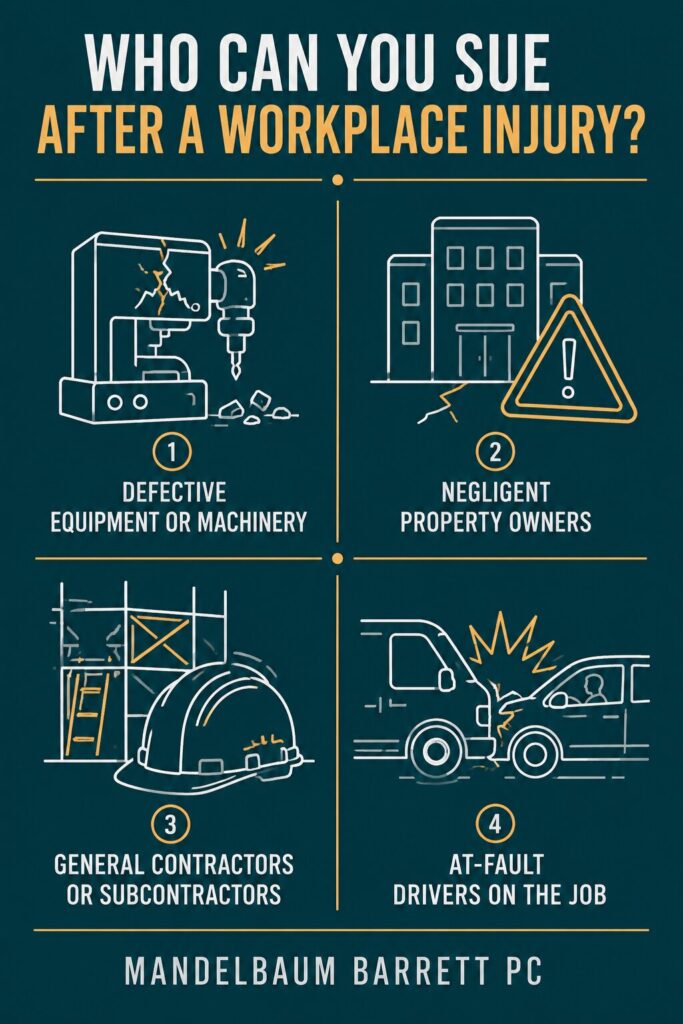
Common examples of third parties who may be held liable include:
- Equipment manufacturers: If a defective machine, tool, or piece of safety gear caused your injury, the manufacturer may be responsible under product liability law.
- Property owners: If you were hurt on someone else’s property, the owner may have failed to maintain a safe environment.
- General contractors or subcontractors: On construction sites, multiple companies are often present, and negligence by another contractor can give rise to a third-party claim.
- Drivers of other vehicles: If you were in a work-related vehicle accident caused by another driver, that driver may be liable.
Unlike workers’ comp, a third-party lawsuit allows you to seek full compensation. That includes all of your lost wages, pain and suffering, and other damages that the workers’ comp system does not cover. To learn more about what your case may be worth, visit our page on what your personal injury claim is worth.
What You Need to Prove in a Third-Party Lawsuit
Workers’ comp does not require you to prove fault, but a third-party lawsuit does. You will need to show that the third party owed you a duty of care, failed to meet that duty, and that their failure directly caused your injuries and losses. This is a standard negligence framework, and building a strong case requires gathering evidence, documenting your injuries, and acting quickly.
If you were hurt at a job site, it is also important to preserve records of the incident as soon as possible. Our blog on protecting your rights after a construction site injury walks through the steps you should take in the aftermath of an accident.
The Employer’s Lien on Your Recovery
One thing many injured workers do not know is that if you win a third-party lawsuit, your employer or their workers’ comp insurance carrier has the right to be reimbursed for the benefits they paid out to you. This is called a workers’ compensation lien. While this may reduce your net recovery, it does not eliminate the value of pursuing a third-party claim. In serious injury cases, the total compensation available through a combined workers’ comp and third-party claim can far exceed what workers’ comp alone would provide.
Time Limits for Filing a Third-Party Claim in New Jersey
Timing matters. New Jersey’s statute of limitations for personal injury claims is two years from the date of your accident. If you miss this deadline, you may lose your right to sue, regardless of how strong your case may be.
There is also an important rule related to inaction. If an injured worker does not take steps to pursue a third-party claim within one year of the accident, the employer or their insurer has the right to pursue that claim on the worker’s behalf. This further underscores why it is important to speak with an attorney as soon as possible after a serious workplace injury.
Contact Mandelbaum Barrett PC for Help With Your Workplace Injury Claim
With decades of experience handling personal injury claims, our experienced attorneys include Certified Civil Trial Attorney Andrew Bronsnick and Co-Chair Joseph J. Peters. Our team understands how to evaluate whether a third-party claim exists alongside your workers’ comp benefits, and we fight to make sure you recover the full compensation the law allows.
If you were injured on the job in New Jersey, do not assume workers’ comp is the end of the road. Contact us today to schedule a free consultation and find out whether a third-party claim may be available in your case.
This content is for informational purposes only and does not constitute legal advice. Please consult with a qualified attorney regarding your specific situation.