
For years, the federal government’s message on cannabis and air travel was simple. Do not bring marijuana to the airport. That messaging has now become significantly more complicated.
On April 27, 2026, the Transportation Security Administration (“TSA”) quietly updated its “What Can I Bring?” webpage to state that “Medical Marijuana” is permitted in both carry on and checked baggage, subject to “Special Instructions.” The change came just days after a federal rescheduling order took effect moving certain cannabis products from Schedule I to Schedule III under the Controlled Substances Act.
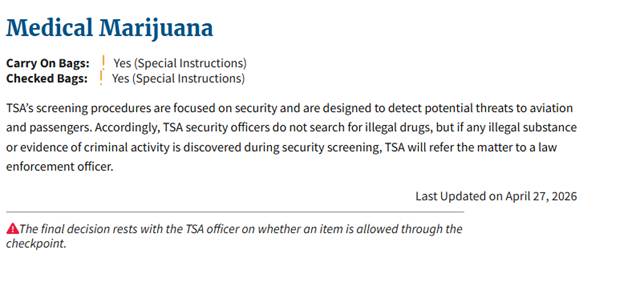
Medical Marijuana | Transportation Security Administration
The update may seem minor, but legally, it is significant. For the first time since the Controlled Substances Act was enacted in 1970, a federal airport security agency publicly acknowledged that at least some forms of cannabis are no longer treated as outright federal contraband.
The problem is that the TSA provided almost no guidance about what this policy actually means in practice.
The confusion reflects the broader uncertainty surrounding federal cannabis rescheduling itself. Effective April 22, 2026, Acting Attorney General Todd Blanche issued an order placing certain state regulated and FDA approved marijuana products into Schedule III under federal law. However, the order did not legalize marijuana generally, nor did it remove all cannabis from Schedule I status. Instead, the order applied only to two categories of cannabis: (1) FDA approved cannabis derived pharmaceuticals; and (2) cannabis products regulated under qualifying state medical marijuana programs.
That means medications like Epidiolex, Marinol, Syndros, and Cesamet now fall within Schedule III treatment under federal law. Certain state authorized medical cannabis products may as well. Recreational marijuana, however, remains a Schedule I controlled substance under federal law and is not subject to this change.
In practical terms, this creates a legal distinction many travelers may not fully understand. A state licensed medical marijuana product obtained through a qualifying medical program may now receive different federal treatment than a recreational cannabis product purchased from a dispensary, even if the products appear identical. The legal status of the cannabis may now depend entirely on the paperwork attached to it.
The TSA’s revised webpage reflects this change in subtle but important ways. The agency removed language that previously stated marijuana was illegal under federal law. It also edited its longstanding disclaimer that TSA officers do not search for “marijuana or other illegal drugs.” The revised version now references only “illegal drugs,” notably omitting marijuana altogether.
Yet, despite labeling medical marijuana as permitted with “Special Instructions,” the TSA failed to publish any actual instructions.
That omission is particularly striking because the TSA routinely provides detailed guidance for other regulated items. Firearms, for example, may be transported only if unloaded, locked in a hard sided container, declared at check in, and placed in checked baggage. Lithium batteries are subject to watt hour restrictions and carry on limitations. Medical liquids have separate declaration and screening requirements.
For medical marijuana, however, there is no published guidance addressing quantity limits, required documentation, packaging requirements, or procedures for interstate travel. The TSA has not explained whether patients must carry medical cards, physician certifications, dispensary receipts, or products in original packaging. Nor has the agency clarified how officers should handle passengers traveling between states with differing cannabis laws.
Importantly, the TSA’s standard referral language remains unchanged. If a TSA officer discovers cannabis during screening, the officer may still refer the matter to local law enforcement. At that point, enforcement decisions may depend heavily on state law and local policing practices.
That reality creates a patchwork of legal uncertainty for travelers. A passenger departing from a state with robust medical marijuana protections may still encounter legal complications while connecting through or arriving in states with stricter cannabis laws. The federal rescheduling order did not override state criminal statutes, nor did it establish uniform national enforcement standards.
To be clear, nothing meaningful has changed for recreational cannabis consumers. Federal law still classifies recreational marijuana as Schedule I, and travelers carrying recreational cannabis remain exposed to potential criminal consequences, even when flying between states where recreational use is lawful under state law.
For medical marijuana patients, however, the situation is now far less straightforward than federal authorities historically suggested. As of April 22, 2026, certain marijuana products regulated under qualifying state issued medical marijuana licenses are no longer classified as Schedule I controlled substances under federal law. The TSA’s own website now reflects that distinction.
What remains missing is a workable enforcement framework.
At present, the federal government has acknowledged that some medical marijuana may legally travel through airport security checkpoints, but it has not meaningfully instructed travelers or TSA officers themselves how that process is supposed to work. Until additional federal guidance is issued, medical cannabis patients should proceed cautiously, carry all available documentation, maintain products in original packaging whenever possible, and understand that local law enforcement may still become involved.
The legal landscape surrounding cannabis continues to evolve rapidly. The TSA’s quiet policy revision may ultimately prove to be an important milestone in federal cannabis reform. For now, however, it represents something more limited. Federal law has changed faster than federal enforcement procedures have been able to keep up.
Mandelbaum Barrett PC’s Cannabis, Hemp & Psychedelics attorneys stand at the forefront of a dynamic and ever-evolving legal landscape. We possess a detailed understanding of laws associated with the production, sale, use, and regulation of a broad range of controlled substances — from cannabis and hemp to psychedelics.
Disclaimer:
The information provided in this post is for general informational purposes only and does not constitute legal advice. While we strive to ensure the accuracy and timeliness of the content, laws and regulations frequently change, and the information may not reflect the most recent developments. If you require legal advice or assistance, please contact Joshua Bauchner or Natalie Diaz.