
If you were hurt in an accident in New Jersey and the other party is claiming that you might share some of the blame, your ability to recover compensation is not necessarily lost. New Jersey follows a modified comparative negligence rule, meaning that even if you played some role in what happened, you may still be entitled to damages as long as your share of fault does not exceed 50%.
At Mandelbaum Barrett PC, our personal injury attorneys have decades of experience guiding injured people through the legal process in New Jersey. We help clients cut through the confusion of fault and liability so they can make informed decisions about their claims.
What Modified Comparative Negligence Means for You
New Jersey’s modified comparative negligence law is found in N.J.S.A. 2A:15-5.1. The rule works as follows: if you are found partially at fault for your injuries, your total compensation is reduced by the percentage of fault assigned to you. However, if you are found to be 51% or more at fault, you cannot recover anything at all.
Say, for example, you are injured in a car accident, and a jury determines the other driver was 80% responsible while you were 20% responsible. If your total damages are $100,000, you would receive $80,000 after the 20% reduction. That same principle applies whether your case involves a car accident, a slip and fall, or a pedestrian collision.
The 51% Rule and Why It Matters
The key threshold in New Jersey is the 51% bar. If your fault reaches or surpasses that level, you are legally barred from recovering any compensation. This makes the specific percentage of fault assigned to each party a critical issue in any personal injury case. Insurance adjusters and defense attorneys know this, and they will often push to assign you a higher percentage of fault to either reduce or eliminate your recovery.
How Fault Gets Assigned
Fault is not always clear-cut. It is determined by reviewing police reports, witness statements, surveillance footage, physical evidence, and expert testimony. Factors like whether you were wearing a seatbelt, whether you were speeding, or whether you failed to avoid a hazard you reasonably should have seen can all come into play. Jurors are instructed to evaluate each party’s conduct and assign percentages based on their overall contribution to the accident.
How Shared Fault Can Affect Different Types of Claims
The comparative negligence standard applies across a wide range of personal injury cases in New Jersey, not just car accidents. Understanding how fault plays out in specific scenarios can help you see how the law might affect your situation.
Car Accidents
In a rear-end collision, you might assume the driver behind you is always fully at fault. However, if you stopped suddenly without cause or your brake lights were not working, a portion of the fault could be assigned to you. Even a modest reduction in your percentage, say, from 25% to 10%, can meaningfully increase your recovery of economic and non-economic damages.
Slip and Fall Cases
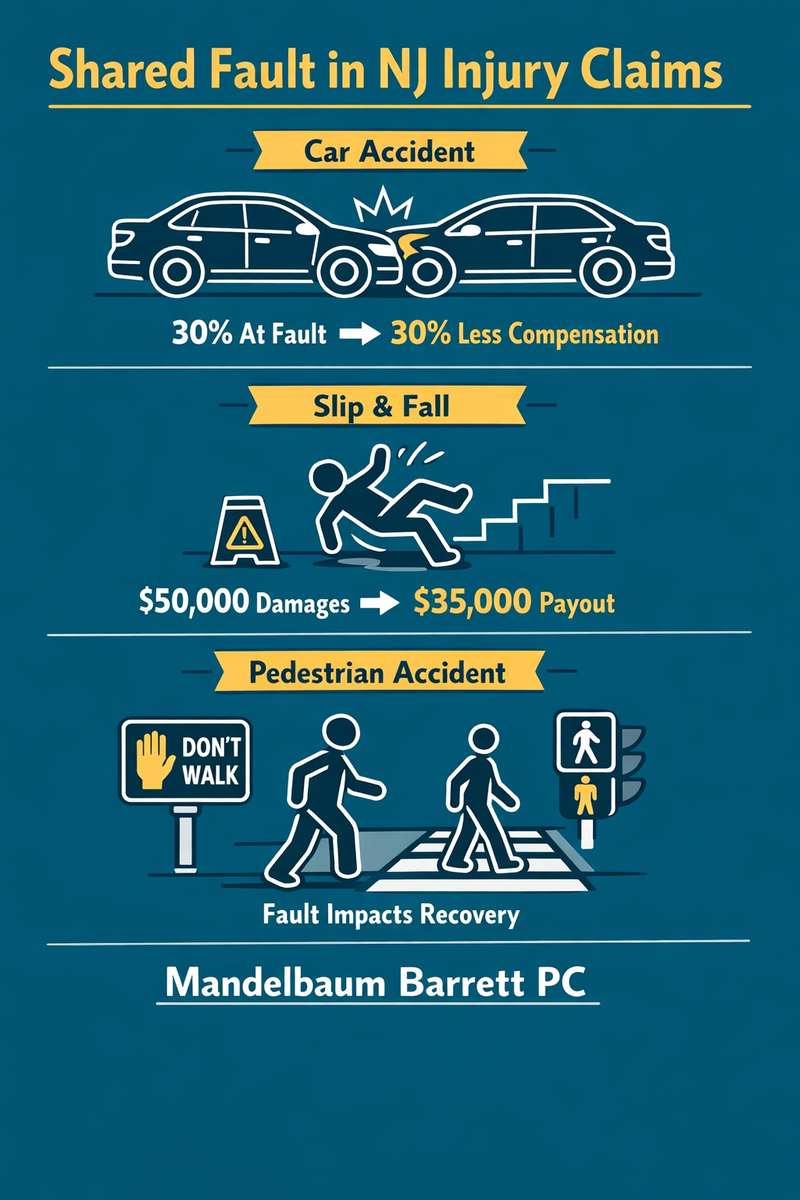
Property owners in premises liability cases often contend that the injured party failed to pay attention or disregarded clear warnings. An attorney can be crucial in distinguishing between your contributory conduct and the property owner’s negligence. Under this system, if a jury determines you were 30% at fault for a fall resulting in $50,000 in damages, your awarded compensation would be reduced to $35,000.
Pedestrian Accidents
Pedestrian cases often involve disputed facts about crosswalk use, traffic signals, and visibility. While drivers owe a high duty of care to those on foot, a pedestrian who crosses outside a crosswalk or against a signal may be assigned some percentage of fault. Pedestrian accident evidence, like traffic camera footage or eyewitness accounts, can make or break how fault is divided.
What You Should Know About Insurance Adjusters and Fault Disputes
When you file a personal injury claim, the at-fault party’s insurance company will conduct its own investigation. Their goal, in many cases, is to find ways to assign more fault to you, which directly reduces the amount they owe. Adjusters may point to statements you made at the scene, posts on your social media profiles, or gaps in your medical treatment as evidence that the accident was partly your fault.
It is worth noting that what you post on social media after an accident can be used against you in this process. Even an innocent photo or comment can be taken out of context to suggest you were not as injured as you claim or that you were partially responsible for the incident. How pain and suffering are calculated in your claim is directly tied to this process, making it important to protect your claim from the start.
These factors make it critical to have a clear, well-documented account of what happened before engaging with an insurance company on your own.
Speak With Mandelbaum Barrett PC About Your Claim
When fault is contested in a personal injury case, the outcome often comes down to how well the evidence is organized and presented. With decades of experience handling personal injury claims, our experienced attorneys include Certified Civil Trial Attorney Andrew Bronsnick and Co-Chair Joseph J. Peters. Our team understands the tactics insurers use to shift blame, and we work diligently to make sure the facts of your case are fully and fairly represented. If you were injured and believe another party was at fault, even if you think you may have contributed to the accident in some way, you may still have a path to recovery under New Jersey law. Reach out to our team today to discuss the details of your case.