
After a serious accident, your health insurance steps in to cover your medical bills. But once you receive a settlement from the at-fault party, your insurer may come back and demand reimbursement for what it paid. That process is called subrogation, and without the right legal protection in place, it can take a significant bite out of your recovery. Connecticut’s “make whole” doctrine is a rule that prevents this from happening until you have been fully compensated for your losses.
At Mandelbaum Barrett PC, our personal injury attorneys understand how confusing and frustrating it can feel to fight for a fair settlement only to see a portion of it disappear. With decades of experience handling personal injury claims, our attorneys Michael Jones and Sean Hamill. We are here to make sure the law works in your favor.
What Is Subrogation and Why Does It Matter?
When your health insurer pays your medical bills after an accident caused by someone else, it gains a legal right to seek repayment from whatever you recover. This is subrogation. For example, if your insurer paid $30,000 in medical costs and you later settle your personal injury claim for $50,000, your insurer may argue it is entitled to the $30,000 it spent.
Without a legal safeguard, subrogation can leave accident victims in a difficult position. A settlement that looks adequate on paper may not actually cover all your losses once the insurer takes its share.
How the Make Whole Doctrine Changes the Equation
Connecticut’s make-whole doctrine says a health insurer cannot exercise its subrogation rights until the injured person has been fully compensated for all of their losses. “Made whole” means exactly what it sounds like: you must be restored, as completely as possible, to the financial position you were in before the accident before any insurer can claim part of your recovery.
This matters because many personal injury settlements do not fully compensate victims. Insurance policy limits, comparative fault rules, and the difficulty of proving every element of pain and suffering can all reduce the amount you receive. The make-whole doctrine acknowledges that reality.
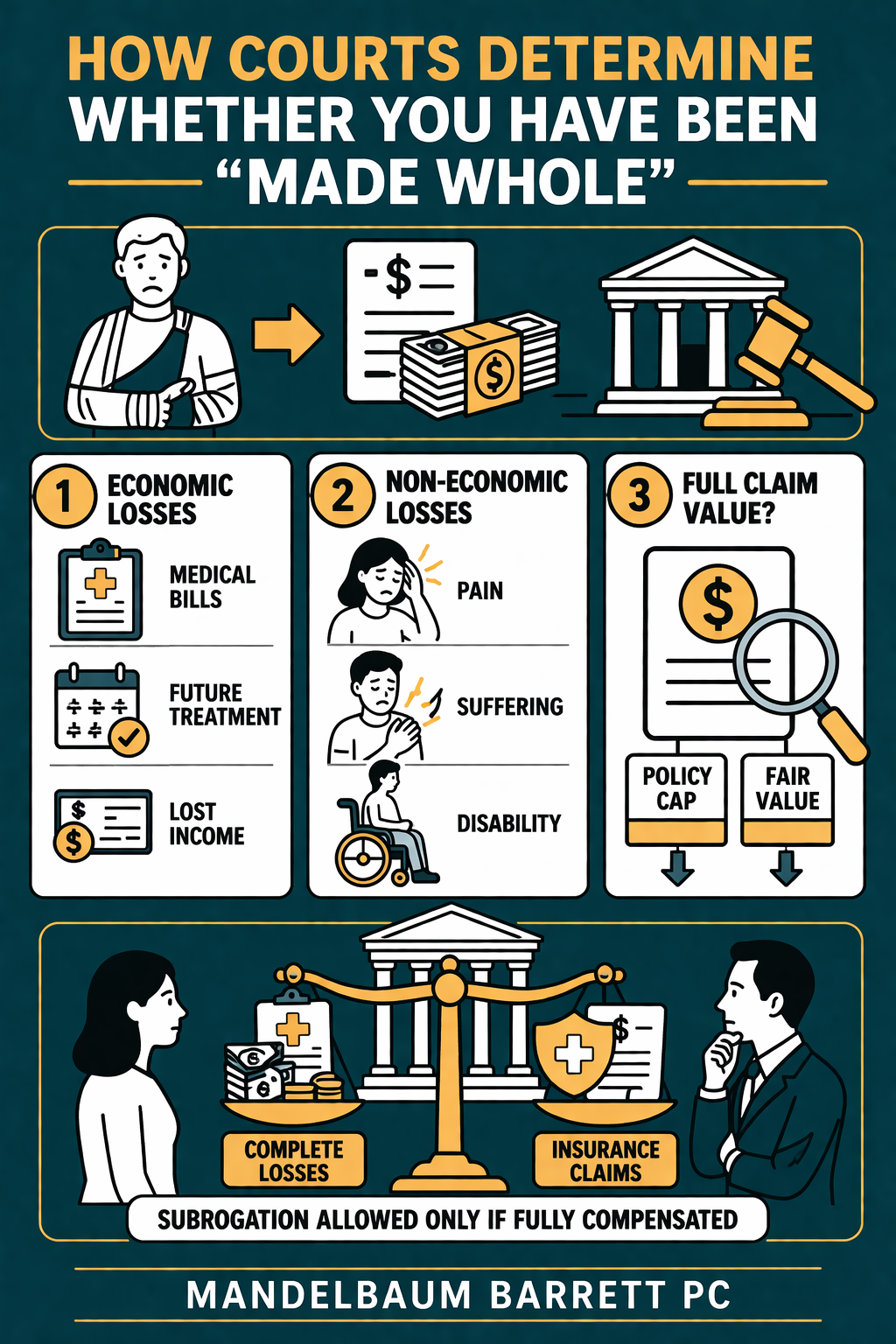
How Courts Determine Whether You Have Been “Make Whole”
Connecticut courts look at the full picture of a victim’s losses when evaluating a make-whole claim. This includes not just current medical expenses, but future costs, lost wages, and non-economic damages such as pain, suffering, and loss of enjoyment of life. A thorough analysis of what you have lost compared to what you have recovered is central to applying this doctrine.
The following factors are typically weighed in this analysis:
- Total economic losses: Medical bills, future treatment costs, lost income, and out-of-pocket expenses
- Non-economic losses: Pain and suffering, emotional distress, and disability
- The settlement amount: Whether it genuinely reflects the full value of the claim or was limited by circumstances like policy caps
This is what helps courts figure out if an insurance company is asking for their money back too soon. If the victim’s total damages are clearly more than the settlement they received, the insurance company can’t demand the full amount they paid be reimbursed.
Why Having an Attorney Makes a Difference
Applying the make whole doctrine is not automatic. You have to assert it, document your losses, and present a compelling case that your settlement fell short of full compensation. Insurers do not volunteer to give up their subrogation rights. They will argue aggressively that you have been made whole even when you have not.
An experienced personal injury attorney can evaluate the full scope of your catastrophic or serious injuries and build a record showing the gap between your actual losses and what you recovered. That documentation, combined with a clear legal argument, gives the made-whole doctrine real force. Connecticut law also recognizes that insurers bear the burden of proving they are entitled to subrogation proceeds, which is another critical reason to have legal representation on your side.
Protect Your Recovery with Mandelbaum Barrett PC
When health insurance subrogation threatens to reduce what you rightfully deserve after an accident, Connecticut law gives you tools to fight back. The make-whole doctrine is one of the most important of those tools, and understanding how to use it can mean the difference between a recovery that truly restores your life and one that falls short.
At Mandelbaum Barrett PC, our attorneys, including Michael Jones and Sean Hamill bring decades of personal injury experience to every case. We handle the legal complexity so you can focus on healing. If a health insurer is pursuing your settlement funds, contact us today to discuss how we can protect your recovery.