
New Jersey has hundreds of miles of coastline, rivers, and lakes that draw boaters every summer, but when alcohol enters the picture, a fun day on the water can turn deadly. Boating under the influence is one of the most dangerous and legally serious situations a person can face on New Jersey’s waterways, and the consequences extend far beyond criminal penalties.
If you were hurt in a boating accident caused by an impaired operator, understanding your legal rights is critical. At Mandelbaum Barrett PC, our personal injury attorneys have decades of experience fighting for accident victims throughout New Jersey. We know how overwhelming these situations can feel, and we are here to help you pursue the full compensation you deserve.
What Is Boating Under the Influence in New Jersey?
New Jersey law makes it illegal to operate a vessel while impaired by alcohol or drugs. Under N.J.S.A. 12:7-46, a person can be charged with boating under the influence, commonly called BUI or BWI, if they operate a vessel with a blood alcohol concentration (BAC) of 0.08% or higher, or if alcohol or drugs have affected their physical coordination and mental abilities to the point that they pose a danger to themselves or others. The law covers motorized watercraft as well as non-motorized vessels that are at least 12 feet in length.
New Jersey law enforcement takes BUI seriously. The New Jersey State Police Marine Service Bureau and the U.S. Coast Guard actively patrol the state’s waterways, including back bays, rivers, lakes, and ocean inlets. Officers can stop a vessel and conduct field sobriety tests, and boat operators are required under implied consent laws to submit to breathalyzer testing when asked.
What Are the Penalties for a BUI in New Jersey?
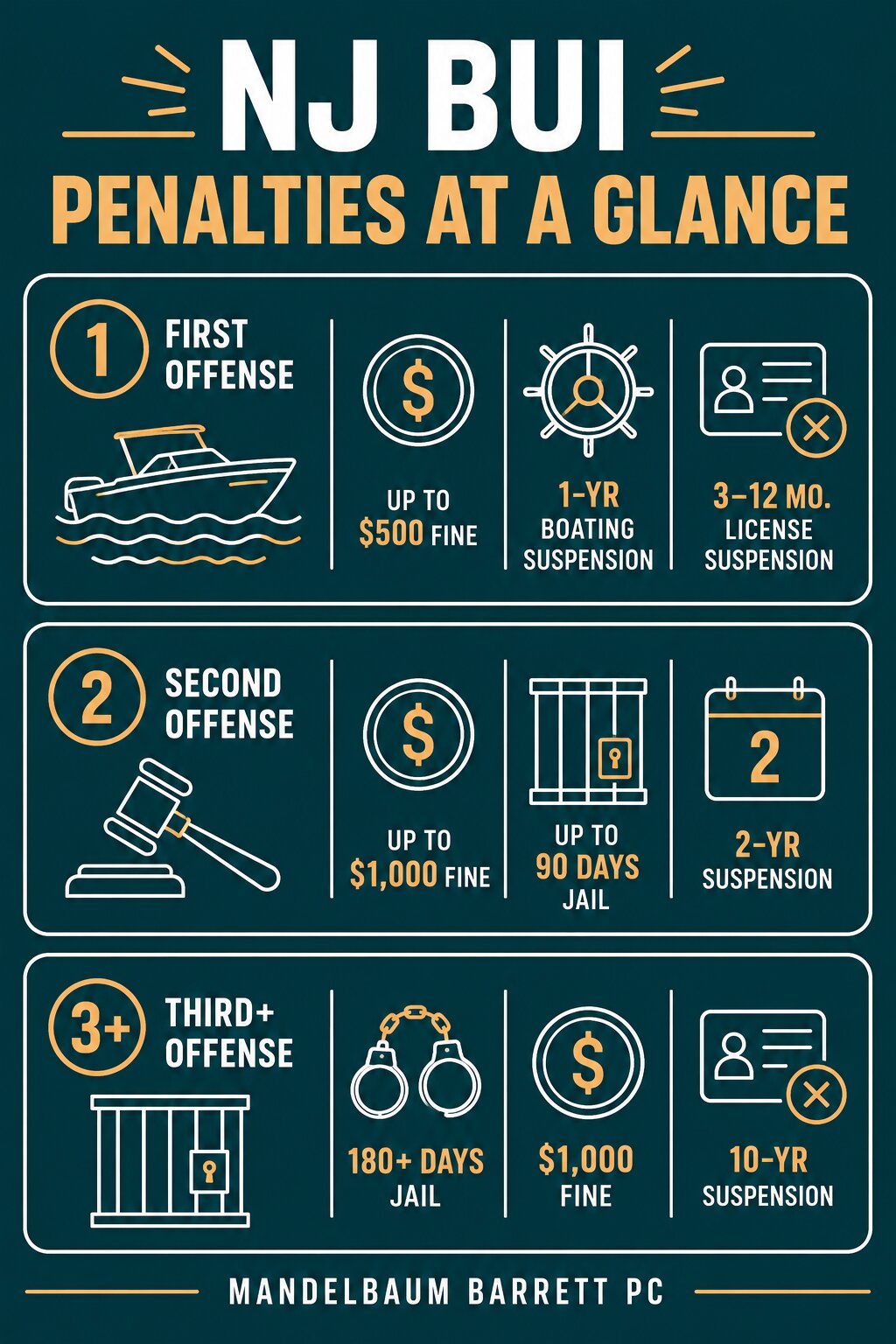
The penalties for a BUI conviction in New Jersey are similar to those for a standard DWI on land and can affect both your boating privileges and your driver’s license.
For a first offense with a BAC between 0.08% and 0.10%, a convicted person faces fines ranging from $250 to $400, a one-year suspension of boating privileges, and a three-month driver’s license suspension. First-time offenders with a BAC above 0.10% or impairment from drugs face fines up to $500, a one-year boating suspension, and a driver’s license suspension of seven months to one year.
Repeat Offenses Carry Heavier Consequences
A second BUI conviction within ten years brings fines up to $1,000, between two and 90 days in jail, six months of community service, and a two-year suspension of both boating and driving privileges. A third or subsequent conviction within ten years means at least 180 days in jail, $1,000 in fines, and a ten-year suspension of both licenses. These consequences can reshape a person’s entire life.
How to Prove Liability When a BUI Causes an Accident
A BUI charge is a criminal matter, but it is separate from the civil liability that an impaired boat operator can face when their actions injure someone else. If a negligent or intoxicated boater causes an accident that injures you, you may have the right to pursue a personal injury claim for compensation. According to the U.S. Coast Guard’s accident statistics, alcohol remained the leading known contributing factor in fatal boating accidents in 2023, accounting for 17% of all boating fatalities that year.
To succeed in a personal injury claim, you generally need to show that the boat operator had a duty of care to others on the water, that they breached that duty through impaired or reckless operation, that this breach directly caused the accident, and that you suffered real harm as a result. A BUI arrest or conviction can serve as strong evidence of negligence in a civil claim, which is why documenting the accident, calling law enforcement, and seeking medical attention immediately are all so important.
The process of proving negligence in a boating accident follows many of the same principles as other personal injury cases, but it can involve additional layers of complexity, including maritime law considerations and the challenge of gathering evidence on the water. Having an experienced attorney by your side from the start gives you the best chance of building a strong case.
What Damages Can You Recover?
When another person’s impaired boating causes you serious harm, New Jersey law allows you to seek compensation for a wide range of losses. These can include medical bills, lost wages, pain and suffering, disability and impairment, and loss of enjoyment of life.
In cases involving catastrophic injuries, such as traumatic brain injuries or spinal damage, the financial impact can last for years. In the most tragic situations where a victim loses their life, surviving family members may have the right to pursue a wrongful death claim against the at-fault operator.
What to Do After a Boating Accident in New Jersey
If you are involved in a boating accident on New Jersey waters, the steps you take immediately after can have a major impact on your ability to recover compensation. Call law enforcement and the Coast Guard right away. Get medical attention even if your injuries do not feel serious at first, as adrenaline can mask pain. Take photographs of the scene, the vessels involved, and any visible injuries. Collect contact information from witnesses. Do not give a recorded statement to any insurance company before speaking with an attorney.
New Jersey also requires boat operators to report accidents to authorities under specific circumstances, including when someone is injured or killed. Failing to follow these reporting requirements can significantly complicate a claim.
Contact Mandelbaum Barrett PC After a New Jersey Boating Accident
When a day on the water becomes a tragedy because of someone else’s reckless choice to boat while impaired, you should not have to face the legal system alone. The evidence needs to be preserved, the liable parties need to be identified, and your rights need to be protected as quickly as possible.
With decades of experience handling personal injury claims, our experienced attorneys include Certified Civil Trial Attorney Andrew Bronsnick and Co-Chair Joseph J. Peters. If you were hurt in a boating accident caused by a drunk or impaired operator, contact our office today to schedule a free consultation and learn how we can help you fight for the compensation you deserve.
This content is for informational purposes only and does not constitute legal advice. Please consult with a qualified attorney regarding your specific situation.